 УЗ
УЗ
 РУ
РУ
 EN
EN
 العربية
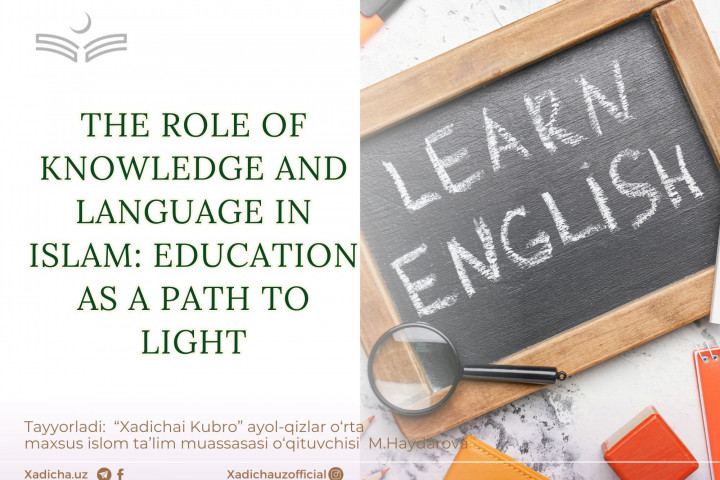
The Role of Knowledge and Language in Islam: Education as a Path to Light
The Role of Knowledge and Language in Islam: Education as a Path to Light
By Munirakhon Khaydarova, Khadichai Kubro Madrasah, Tashkent
Abstract
Islam places extraordinary emphasis on knowledge, reflection, and understanding. From the very first revelation, “Read, in the name of your Lord who created” (Qur’an 96:1), Muslims are reminded that learning is both a spiritual duty and a means of improving the world. This article explores the connection between knowledge, language, and faith in Islam. It highlights how language learning and education serve as tools for self-development, intercultural dialogue, and moral growth. The discussion also considers how institutions such as Khadichai Kubro Women’s Madrasah can continue the noble Islamic tradition of combining knowledge with faith to empower women and strengthen society.
Keywords: Islamic education, knowledge, language, women’s education, spirituality, moral development
Introduction
Throughout Islamic history, the pursuit of knowledge has been a sacred duty. The Prophet Muhammad (peace be upon him) said, “Seeking knowledge is an obligation upon every Muslim — male and female.” This timeless message shows that education in Islam is not limited to worldly skills but also includes the search for understanding, truth, and spiritual refinement.
Language, as the main tool of communication and learning, holds a special place in this process. The Qur’an itself was revealed in Arabic — a language that not only conveys meaning but also carries deep spiritual beauty. Yet Islam encourages the learning of other languages too, for they help believers communicate wisdom, share knowledge, and build peace among nations.
In today’s world, where cultures and ideas constantly interact, language and knowledge together form a bridge between faith and modernity. For young women studying at Khadichai Kubro Women’s Madrasah, this balance — between spiritual values and intellectual achievement — represents the essence of Islamic education.
The Value of Knowledge in Islam
Knowledge (‘ilm) is one of the central concepts in Islam. The Qur’an mentions the word ‘ilm and its derivatives more than 700 times, showing its immense importance. Islam views knowledge as light — a divine gift that leads people out of ignorance and into understanding.
Muslim scholars throughout history, such as Al-Ghazali, Ibn Sina, and Ibn Rushd, saw no conflict between faith and reason. They believed that learning about the world deepens one’s appreciation of the Creator. Al-Ghazali wrote that true knowledge is that which brings one closer to Allah. Thus, studying science, language, and the arts — when done with good intention — becomes an act of worship.
For women, education is equally significant. From the early days of Islam, women scholars like Aisha bint Abu Bakr and Fatimah al-Fihri contributed to the spread of knowledge. Al-Fihri even founded the world’s first university, Al-Qarawiyyin in Morocco. Their legacy inspires the modern Muslim woman to continue learning and teaching, guided by both intellect and faith.
Language as a Tool of Understanding and Unity
Language is the key to human connection. Through language, we express thoughts, share emotions, and build communities. In Islam, clear and respectful speech is considered a sign of good character. The Prophet Muhammad (peace be upon him) advised, “Whoever believes in Allah and the Last Day should speak good or remain silent.”
Learning multiple languages enables Muslims to spread knowledge and understanding beyond borders. It allows them to access scientific discoveries, communicate with people of different faiths, and correct misunderstandings about Islam. For instance, knowing English helps young Muslims share the beauty of their faith with the wider world, while learning Arabic strengthens their connection to the Qur’an and Islamic scholarship.
At Khadichai Kubro Women’s Madrasah, language education therefore serves a dual purpose — it equips students with practical skills for the modern world and helps them express Islamic values with confidence and grace.
Education and Moral Development
Islamic education is not only about accumulating information; it is about forming good character (akhlaq). A truly educated person is one whose knowledge benefits others. The Prophet (peace be upon him) said, “The best among you are those who learn the Qur’an and teach it.” This teaching shows that knowledge gains its true worth when shared with sincerity and humility.
Modern education can sometimes focus too much on competition and material success. However, Islamic education reminds students that learning must also serve the heart. Teachers at institutions like Khadichai Kubro Women’s Madrasah guide their students not only to master languages and sciences but also to apply them ethically — with honesty, kindness, and social responsibility.
When young women study with these principles in mind, they become role models of balanced education — combining intellect with faith, and success with compassion.
Empowering Women Through Knowledge
Educating women has always been a cornerstone of Islamic civilization. When women are educated, entire communities thrive. They raise informed families, contribute to society, and preserve moral and cultural values. The Qur’an honors women as equal spiritual beings: “Indeed, the most noble of you in the sight of Allah is the most righteous of you” (49:13).
In the modern context, knowing languages and possessing diverse knowledge empowers women to take part in social, educational, and humanitarian fields while upholding Islamic ethics. For students of Khadichai Kubro Women’s Madrasah, this means becoming educators, translators, writers, and leaders who represent Islam with dignity and wisdom.
Conclusion
The pursuit of knowledge and the mastery of language are sacred responsibilities in Islam. They illuminate the path toward both worldly and spiritual success. In an age of globalization, these two elements — faith and education — must walk hand in hand.
For the young women of Khadichai Kubro Women’s Madrasah, learning is more than an academic duty; it is a journey of faith. Every word learned, every language mastered, and every book read brings them closer to understanding Allah’s creation and fulfilling their purpose as wise, compassionate members of the Ummah.
By following the Qur’anic call to “read” and the Prophet’s encouragement to seek knowledge, Muslim women today can carry forward the light of education that has shone through Islamic history — a light that continues to guide humanity toward truth, peace, and understanding.
References
Al-Ghazali, A. H. (2001). The revival of the religious sciences (Ihya’ ‘Ulum al-Din). Islamic Texts Society.
Nasr, S. H. (2012). Islamic philosophy from its origin to the present: Philosophy in the land of prophecy. State University of New York Press.
Rahman, F. (1982). Islam and modernity: Transformation of an intellectual tradition. University of Chicago Press.
Woodrow, L. (2018). Introducing course design in English for specific purposes. Routledge.
Viana, V., Bocorny, A., & Sarmento, S. (2019). Teaching English for specific purposes. Cambridge Scholars Publishing.
Другие новости


Наши контакты
| Телефон: | +998 (71) 248-47-52 |
| E-mail: | xadichai-kubro@umail.uz |
| Адрес: | Toshkent shahar, Olmazor tumani, Fayziobod ko'chasi, 1-uy |